|
Travel to Delphi
|
 |
| Delphi Tour |
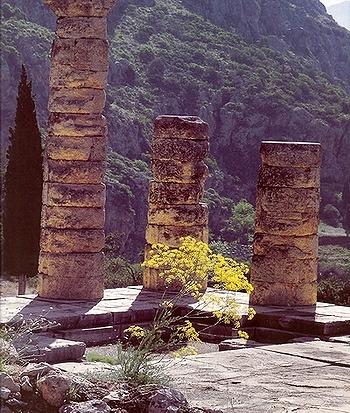
Delphi is an Ancient City in the prefecture of Fokida, on the south side of mount Parnassos. The Ancient Greeks considered it to be the centre of the world. Today there are about 1,500 permanent residents in Delphi.
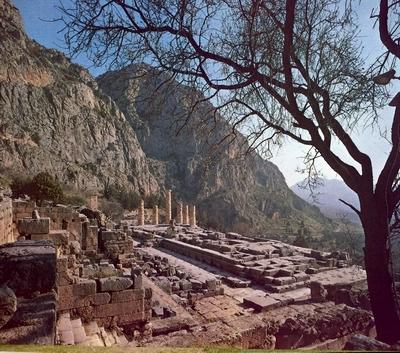
Apollo's temple (background)
It is a tourist attraction, particularly during the winter as nearby mount Parnassos has a well known ski resort, and all year round as well since it is home to very important Ancient monuments and findings and especially the world renowned Delphi Oracle.
Apart from from the Oracle, many archaeological monuments are found in the area, chief among which are Apollo's and Athena's temples. Archaelogists speculate that organized life began in Delphi as early as 1500 B.C. The Delphi Oracle, which was the most important in Ancient Greece, is located in a place called Pytho, and initially belonged to the goddess Gee (Earth) who offered it to Apollo. This god, after killing Python, the area's dragon, became master of the Oracle. The dragon was named after the location, Pytho. Apollo was then named Pythian, the Oracle's soothsayer was named Pythia and the festivities in honor of Apollo were named "Pythia". The oracle slowly became not only a religious centre, but a political centre as well. Anyone could consult the Oracle, be it a civilian or representatives of a city-state. To obtain advice from the Oracle, one would have to bathe in the nearby Castallia springs, pay a present day tax equivalent and sacrifice a goat.
They would then enter the temple. In a special chamber, a revered elderly woman, Pythia, would light a fire. Those seeking advice would sit in a specially arranged adjacent room, called "the residence". From that room they would state out loud their problem that required a solution. Pythia would then chew on laurel leaves, walk up to the sacred tripod and while inhaling fumes, would fall into an ecstatic state and start mumbling incomprehensible words. The temple's priests would record these words, put them in order and present them as a rational response to the advice seeker. It was in this fashion that the god Apollo was believed to announce his opinion or will to the people.
|

Walking through Delphi's archaelogical site one can see the Sacred Street. On the left and right hand side of this street, the city-states would place their offerings. In present day many treasures and other offerings are still maintained, from the Kerkyrians, the Arcadians, the Argians, the Spartans, the Sifnians, the Athenians, the Naxians and others. After walking for a while we reach Apollo's temple, that even by present day standards amazes the visitor for it's sheer size. Located inside the temple's inner sanctum, that could only be accessed by very few individuals, was the golden statue of Apollo, Dionysus' grave and the "omphalus" (considered to be the precise centre of the world), a chasm in the floor from where the fumes that Pythia would inhale rose, and the sacred tripod.
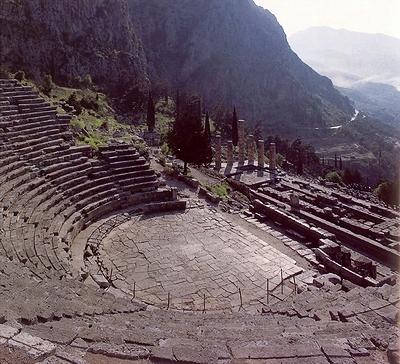
On the northwestern side of the temple one finds the theatre. It is one of the best preserved ancient theatres in Greece. It has a capacity of 5,000 spectators and is made of stone from Mt. Parnassos . From the theatre an uphill path leads to the stadium. Its length is 178 meters. It was in this stadium that the Pythian Games, in honor of god Apollo, took place. They came second in significance, only to the Olympic Games. We can also observe, erected over two levels, the Delphi gymnasium. It's a building complex where the "Pythian" athletes would train. A bit below Apollo's Temple one can observe another masterpiece of Ancient Greek Art, which in this case attains perfection. The Temple of the Goddess Athena. What is of particular interested among other things, are the ruins of the temple's dome with three of its columns still standing.
|
THE MUSEUM
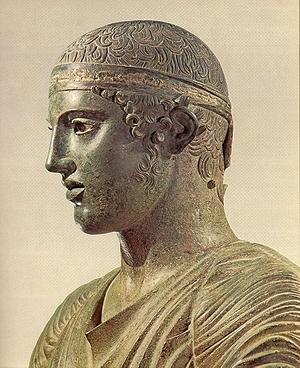
Iniochos - the museum's "trademark" statue
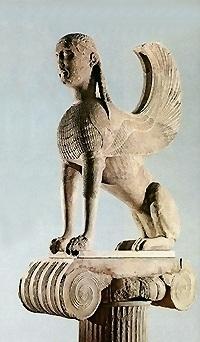
Naxos Sphinx
The Delphi museum is among the most important in the world. In this museum we'll see the "omphalus" (centre of the world), which mimmicks the real "omphalus", located inside Apollo's Temple. According to ancient tradition, Zeus, the god of gods, in search of the centre of the world, released two eagles from his hands. The eagles met in Delphi and as such the area was labelled as the centre of the world. In the museum one can see the statue of Iniochos, the Naxos Sphinx, the Twin "Kourous" (young men) , the marble statue of Dionysus,
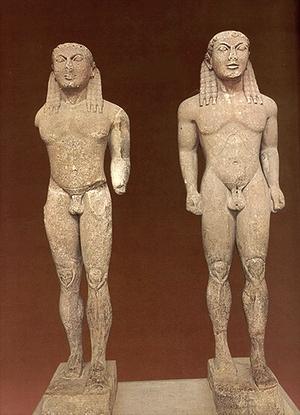
Twin Kouros
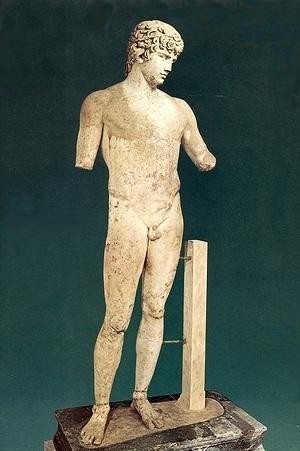
Andinoos
and the Statue of Andinoos - companion of emperor Adrian and thousands of other important exhibits.
|
The area's natural landscape is magnificent. The visitor can enjoy a comfortable stay as there are numerous good hotels and apartments available to let, that can accomodate any preference. Nearby there's also the village of Arachova, another popular tourist centre. It's a picturesque village right below the top of Mount Parnassos, with vivid nightlife, particularly during the winter without however, a significant drop in activity during the other seasons. Visit Delphi an take an intellectual journey into the area's glorious history. The centre of the earth... you will in fact pick up a positive and peculiar energy in the atmosphere...
|
|